
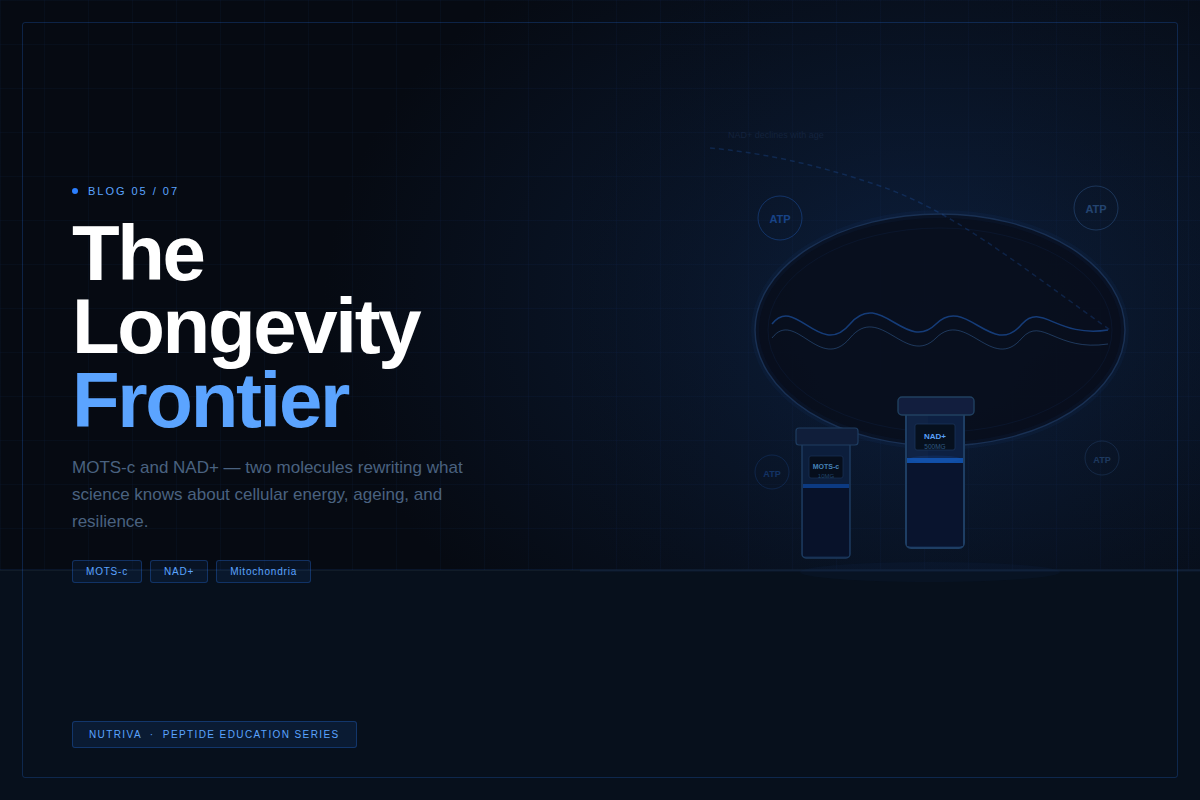
The Longevity Frontier: MOTS-c and NAD+
Two molecules rewriting what science knows about cellular energy, ageing, and resilience
The pursuit of longevity has always driven human curiosity. But the conversation has shifted dramatically in recent years — from philosophical ambition to serious molecular science. At the centre of modern longevity research sit two extraordinary compounds: MOTS-c, a peptide encoded in mitochondrial DNA, and NAD+ (Nicotinamide Adenine Dinucleotide), a coenzyme that sits at the heart of virtually every energy-producing process in the cell.
These are not speculative supplements. They represent two of the most rigorously studied pathways in the biology of ageing — and the tools available to influence them have never been more sophisticated.
MOTS-c: The Mitochondrial Messenger Rewriting Longevity Science
What Is It?
MOTS-c is a 16-amino-acid peptide encoded within the mitochondrial genome — not the nuclear genome, which is where most protein-coding genes live. Its discovery in 2015 by researchers at the USC Davis School of Gerontology was a landmark moment: it revealed that the mitochondria, long thought of primarily as energy factories, are also endocrine organs that communicate with the rest of the body through peptide signals.
MOTS-c is part of a small family of peptides called mitochondria-derived peptides (MDPs) or mitokines — a field of research that is young but moving very fast.
What Does MOTS-c Do?
MOTS-c acts as a metabolic regulator with a remarkable range of effects:
Insulin sensitivity and metabolic health. MOTS-c improves insulin sensitivity and glucose uptake in skeletal muscle. Animal studies have shown it can prevent diet-induced obesity and restore metabolic function — effects that are relevant both to metabolic disease and to optimising body composition.
Exercise performance and muscle function. MOTS-c levels increase dramatically in response to exercise — suggesting it may partly mediate the systemic benefits of physical activity. Research shows it improves muscle function and exercise capacity in animal models, including in aged animals where these functions would normally be significantly impaired.
Anti-ageing and longevity. Studies in C. elegans (a standard model organism for ageing research) have shown MOTS-c to extend lifespan. More relevantly, studies in mice show it increases median lifespan and healthspan — the period of healthy, functional life. In aged mice, MOTS-c supplementation reversed several markers of ageing, including inflammation and metabolic dysfunction.
Stress resilience. MOTS-c appears to regulate adaptive stress responses at the cellular level, including through AMPK activation — a central pathway in cellular energy sensing and longevity-associated processes.
Immune modulation. Emerging research suggests MOTS-c has anti-inflammatory effects and may modulate immune function in ways relevant to both acute illness and chronic inflammatory states.
MOTS-c and Human Ageing
Critically, MOTS-c levels decline with age in humans. Studies have found significantly lower circulating MOTS-c in older individuals compared to younger ones. There's also an association between specific MOTS-c genetic variants and exceptional longevity — a finding that has generated enormous interest in the field.
For the biohacking community, this creates a compelling hypothesis: if MOTS-c declines with age, and if that decline contributes to the metabolic and functional changes we associate with ageing, then restoring or supplementing MOTS-c levels may represent a meaningful intervention against those changes.
How Is It Used?
MOTS-c is available as a research peptide administered via subcutaneous injection. Research protocols typically use doses in the range of 5–10 mg per week. It's often stacked with other longevity-focused compounds, particularly NAD+ precursors and BPC-157.
NAD+: The Coenzyme at the Centre of Life
What Is It?
NAD+ is not a peptide in the strictest sense — it's a dinucleotide coenzyme present in every living cell. But it belongs firmly in any serious discussion of longevity science, and it's closely intertwined with the mitochondrial biology that makes MOTS-c so interesting.
NAD+ is essential for:
- Energy metabolism — it's a critical electron carrier in cellular respiration, enabling the production of ATP (cellular fuel) in the mitochondria
- Sirtuin activation — sirtuins are a family of proteins (SIRT1–SIRT7) that regulate gene expression, DNA repair, metabolism, and inflammation. They are often called "longevity genes" — and they require NAD+ to function
- PARP enzymes — DNA repair enzymes that depend on NAD+ to fix strand breaks and maintain genomic integrity
- CD38 — involved in calcium signalling and immune function
NAD+ and Ageing
NAD+ levels decline substantially with age — by as much as 50% between young adulthood and middle age in many tissues. This decline has been causally linked to many hallmarks of ageing, including mitochondrial dysfunction, reduced DNA repair capacity, increased inflammation, and impaired metabolic function.
Professor David Sinclair of Harvard Medical School, one of the most prominent voices in longevity science, has described NAD+ decline as potentially a central driver of the ageing process — and NAD+ restoration as one of the most promising targets in longevity medicine.
Approaches to Raising NAD+
Direct NAD+ administration has limited bioavailability due to poor cellular uptake. The most effective approaches target NAD+ precursors or related pathways:
NMN (Nicotinamide Mononucleotide) — a direct precursor to NAD+ that is efficiently taken up by cells and converted to NAD+. Well-studied in animal models and increasingly in human trials.
NR (Nicotinamide Riboside) — another precursor with good bioavailability and a growing body of human clinical data.
NAD+ IV infusion — direct IV administration bypasses the absorption challenges of oral routes and produces rapid, significant elevation of NAD+ levels. Used in clinical settings and biohacking contexts for more immediate effects, particularly for cognitive clarity, energy, and recovery.
Injectable NAD+ — subcutaneous or intramuscular injection of NAD+ provides effective systemic delivery with better bioavailability than oral routes and less complexity than IV.
What the Research Shows
Human clinical data on NAD+ precursor supplementation has expanded significantly:
- Improved muscle function and mitochondrial health in older adults (NR trials, published in Nature Communications and Cell Reports)
- Improved insulin sensitivity in overweight adults
- Cognitive and neurological interest — NAD+ pathways are highly relevant to conditions including Parkinson's disease, Alzheimer's disease, and traumatic brain injury
- Cardiovascular protection via sirtuin and PARP activation
- DNA repair enhancement — potentially relevant to cancer risk reduction and healthy ageing
The subjective reports from users of NAD+ IV infusions and high-dose oral precursors include improved energy, mental clarity, mood, and physical performance — effects that align with the mechanistic expectation of restored mitochondrial function.
MOTS-c and NAD+: A Synergistic Pair
These two compounds are deeply interconnected. MOTS-c acts in part through AMPK — an energy sensor that is activated when cellular NAD+/NADH ratios shift. NAD+ is required for the sirtuins that regulate mitochondrial biogenesis. The mitochondria that produce MOTS-c are the same organelles whose function is so profoundly dependent on NAD+ availability.
Using these compounds together is a logical and increasingly common approach among longevity-focused practitioners — each working on the same fundamental problem (mitochondrial and cellular ageing) from a slightly different angle.
The Longevity Mindset
What MOTS-c and NAD+ represent is a shift from reactive medicine to proactive biology. Rather than waiting for disease and treating it, the longevity approach is to identify the upstream mechanisms of biological decline and intervene there — when the intervention is most effective and the potential benefit is greatest.
The science behind both compounds is real, growing, and increasingly compelling. For anyone serious about how they age — not just how long, but how well — these are worth understanding deeply.
Next up: Melanotan 1 and 2 — the peptides behind tanning, libido, and some of the most interesting receptor biology in the field.
Have questions? Chat with us directly on WhatsApp:
Chat with us on WhatsAppRead more
Melanotan 1 and 2: The Science Behind Tanning, Libido, and Melanocortin Receptors
Two of the most discussed peptides in the space — with genuinely different profiles that are worth understanding clearly Few peptides generate as much conversation — or as much confusion — as Mela...
Read more
READ HERE Explore the science behind today's most discussed research peptides. This free ebook covers key compounds, mechanisms of action, potential applications, and important considerations, all...
Read more