
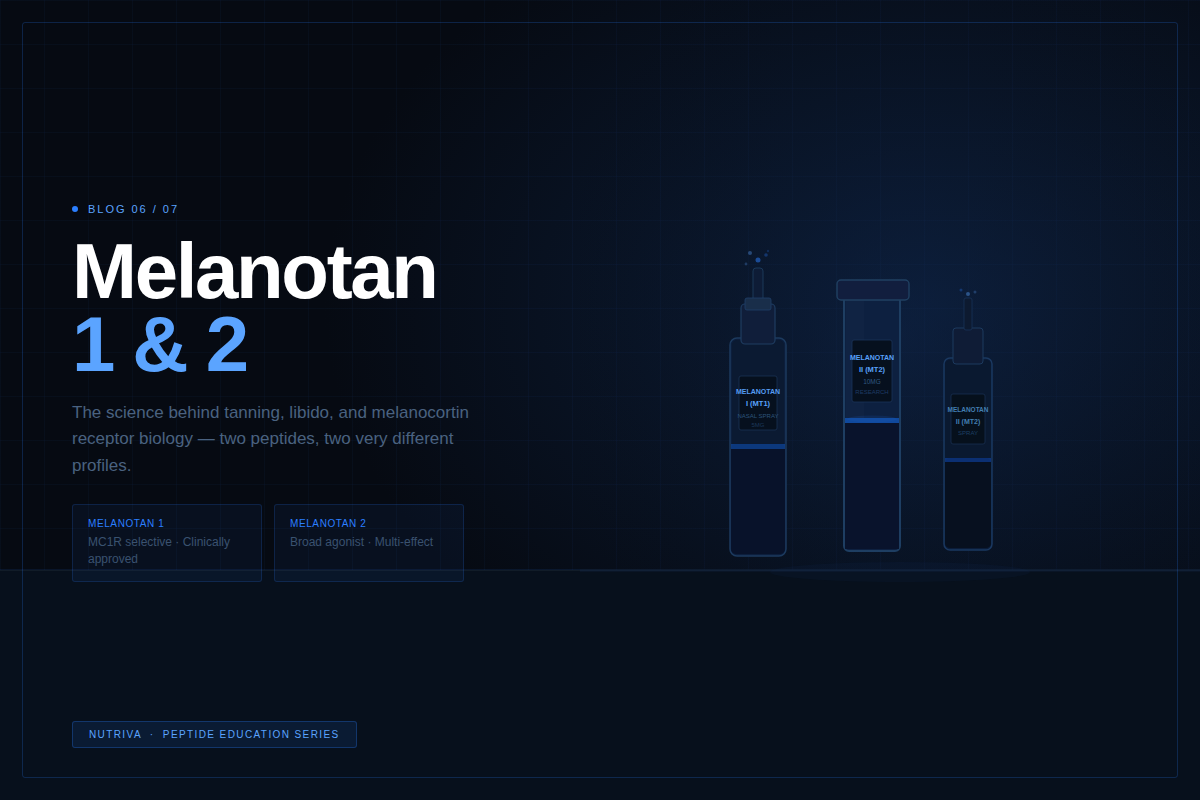
Melanotan 1 and 2: The Science Behind Tanning, Libido, and Melanocortin Receptors
Two of the most discussed peptides in the space — with genuinely different profiles that are worth understanding clearly
Few peptides generate as much conversation — or as much confusion — as Melanotan 1 and Melanotan 2. Both interact with the melanocortin system, both can produce skin darkening, and both are research peptides that have been widely used in the biohacking and health community. But they are meaningfully different compounds with different receptor profiles, different effect ranges, and different risk considerations.
Understanding the distinction matters — not just for outcomes, but for making informed decisions.
The Melanocortin System: A Brief Overview
Melanocortins are a family of peptides derived from proopiomelanocortin (POMC) — a precursor molecule produced in the pituitary gland. They act through five known receptors (MC1R through MC5R), each with distinct tissue distribution and physiological roles:
- MC1R — primarily found on melanocytes (pigment cells in skin); governs melanin production and pigmentation
- MC2R — found in the adrenal gland; regulates cortisol production
- MC3R — involved in energy balance and feeding
- MC4R — expressed widely in the brain; regulates appetite, energy expenditure, and sexual function
- MC5R — found in various exocrine glands
The selectivity — or lack thereof — of a peptide for these receptors determines its effects and its side-effect profile. This is the key to understanding Melanotan 1 versus Melanotan 2.
Melanotan 1 (Afamelanotide): Selective and Clinically Proven
What Is It?
Melanotan 1 (MT-1), developed under the pharmaceutical name Afamelanotide, is a synthetic analogue of alpha-MSH (alpha-melanocyte-stimulating hormone) that is highly selective for MC1R. Its selectivity is its defining characteristic — it primarily acts on melanocytes in the skin to stimulate melanin production, with limited activity at other melanocortin receptors.
Afamelanotide has completed clinical trials and received regulatory approval in Europe and the United States for the treatment of erythropoietic protoporphyria (EPP) — a rare and painful genetic condition in which sunlight exposure causes severe pain due to abnormal porphyrin accumulation. By stimulating melanin production and thickening the skin's protective barrier, Afamelanotide allows EPP patients to tolerate sun exposure that would otherwise be debilitating.
What Does It Do?
- Melanogenesis — stimulates melanocytes to produce eumelanin (the brown/black pigment), producing a tanning effect even without significant UV exposure
- Photoprotection — increased melanin provides some protection against UV damage
- Anti-inflammatory — MC1R activation has been shown to have anti-inflammatory effects in the skin; this is one reason there's interest in MT-1 beyond tanning
- Minimal systemic effects — due to its MC1R selectivity, MT-1 has limited effects on appetite, libido, or neurological function
Side Effects
MT-1/Afamelanotide is generally well tolerated. The most commonly reported effects are nausea (particularly post-injection), flushing, and headache — typically transient. The implantable formulation used in clinical trials bypasses some of these acute reactions.
A theoretical concern with any melanocortin peptide is the stimulation of existing melanocytic naevi (moles). Regular skin monitoring is sensible for anyone using melanocortin-stimulating peptides.
Regulatory Status
Afamelanotide (Scenesse) is FDA-approved and EMA-approved for EPP. Research-grade MT-1 is available as a research peptide.
Melanotan 2: The Broader Melanocortin Agonist
What Is It?
Melanotan 2 (MT-2) is a cyclic analogue of alpha-MSH that, unlike MT-1, is a non-selective melanocortin agonist. It binds to MC1R, MC3R, MC4R, and MC5R — a broader receptor profile that produces a wider range of effects.
MT-2 remains a research peptide and has not received clinical approval for any indication. It has been widely self-administered in the biohacking and bodybuilding communities, and there is a substantial body of user data alongside the preclinical research.
What Does It Do?
Tanning / melanogenesis (MC1R). Like MT-1, MT-2 stimulates melanin production and produces skin darkening. It is typically considered more potent for this effect than MT-1 at comparable doses.
Libido and sexual function (MC4R). This is the effect that most distinguishes MT-2 from MT-1. MC4R activation in the hypothalamus and other brain regions stimulates sexual arousal. This effect is well-documented — so well-documented, in fact, that a more selective MC4R agonist (Bremelanotide / PT-141) was developed specifically for this purpose and is now FDA-approved as Vyleesi for hypoactive sexual desire disorder in women. MT-2 produces similar effects via MC4R, though less selectively.
Appetite suppression (MC3R, MC4R). MC3R and MC4R are involved in energy balance regulation. MT-2 users commonly report reduced appetite — an effect consistent with its receptor profile.
Spontaneous erections. A notable and commonly reported effect in male users is spontaneous or prolonged erections, particularly in the early days of use. This is a direct MC4R effect. It is the reason some users titrate dose carefully.
Side Effects and Considerations
MT-2's broader receptor profile means a broader side-effect profile:
- Nausea and flushing — particularly at higher doses or early in use; typically reduced as the body adjusts
- Facial flushing — a common early-use effect
- Yawning — a somewhat idiosyncratic but commonly reported effect, linked to MC4R activity
- Increased blood pressure — transiently, in some users
- Darkening of existing moles — a recognised consideration; skin monitoring is recommended
- Priapism risk — prolonged, painful erection is a risk with excessive dosing; this requires medical attention if it occurs
The spontaneous erection effect, while a desired outcome for some, is unwanted for others, and is a key reason many users prefer PT-141 (which is more selectively MC4R-targeted) or MT-1 (which avoids this pathway entirely) depending on their goals.
Who Uses It and Why?
MT-2 has been used for:
- Cosmetic tanning without UV exposure
- Sexual enhancement / libido support
- Appetite management as part of body composition protocols
It is a research peptide, and its use is for investigational purposes.
MT-1 vs MT-2: Choosing Intelligently
| Feature | Melanotan 1 (MT-1) | Melanotan 2 (MT-2) |
|---|---|---|
| Receptor selectivity | Highly selective MC1R | MC1R, MC3R, MC4R, MC5R |
| Tanning effect | Yes, strong | Yes, very strong |
| Sexual effects | Minimal | Significant (MC4R) |
| Appetite suppression | Minimal | Common |
| Nausea | Mild | More pronounced at higher doses |
| Clinical approval | Yes (Afamelanotide for EPP) | Research only |
| Best for | Tanning, photoprotection | Tanning + libido + appetite |
A Note on Sun Safety
It's worth being clear: while both Melanotans increase melanin production and provide some degree of photoprotection, they do not replace sun safety practices. Melanin produced exogenously-stimulated melanogenesis does not replicate the full photoprotective response of natural UV-induced tanning. SPF, UV avoidance during peak hours, and skin monitoring remain important.
The Research Trajectory
Melanocortin science is a genuinely interesting field. The clinical success of PT-141/Bremelanotide for HSDD, and Afamelanotide for EPP, demonstrates that highly targeted melanocortin receptor agonism can produce significant clinical benefits. Further research is exploring MC4R agonism for obesity treatment — the appetite-suppressing effects of this receptor pathway are of significant pharmaceutical interest.
For the research and biohacking community, these compounds represent a well-understood, biologically coherent set of tools — with clear effects, understood mechanisms, and manageable risk profiles when used thoughtfully.
In our final blog: The most important topic of all — peptide purity, storage, handling, and why quality is the foundation everything else is built on.
Have questions? Chat with us directly on WhatsApp:
Chat with us on WhatsAppRead more
What Are Peptides? The Building Blocks of the Body's Own Intelligence
An introduction to the molecules powering the next frontier of human optimisation There's a quiet revolution happening in the world of health and performance — and it's being driven not by synthet...
Read more
The Longevity Frontier: MOTS-c and NAD+
Two molecules rewriting what science knows about cellular energy, ageing, and resilience The pursuit of longevity has always driven human curiosity. But the conversation has shifted dramatically i...
Read more