Article: The Growth Hormone Axis: CJC-1295, Ipamorelin, and Tesamorelin
%20is%20one%20of%20the%20most%20powerful%20regulatory%20molecules%20in%20the%20human%20body.%20In%20youth,%20it%20driv...)

The Growth Hormone Axis: CJC-1295, Ipamorelin, and Tesamorelin
How peptide science is rewriting the playbook on body composition, recovery, and longevity
Growth hormone (GH) is one of the most powerful regulatory molecules in the human body. In youth, it drives growth, cellular repair, fat metabolism, and physical development. As we age, GH output declines — often substantially — and with it comes changes in body composition, recovery capacity, skin quality, sleep architecture, and overall vitality.
The natural question the research community has explored: what happens when you restore or amplify that signal?
Growth hormone-releasing peptides (GHRPs) and growth hormone-releasing hormone analogues (GHRH analogues) offer a precise, targeted answer. And three of the most studied — CJC-1295, Ipamorelin, and Tesamorelin — have become cornerstones of peptide-based health protocols.
A Quick Primer on How GH Works
Growth hormone isn't released in a constant stream. It's secreted in pulses, primarily overnight during deep sleep, driven by two opposing signals from the hypothalamus:
- GHRH (Growth Hormone-Releasing Hormone) — stimulates GH release from the pituitary
- Somatostatin — inhibits GH release
GHRPs work by mimicking or amplifying these natural signals — either by acting like GHRH (triggering the release mechanism) or by binding to the ghrelin receptor and stimulating GH secretion through a separate pathway. The elegance of this approach is that it works within the body's own regulatory framework, preserving the natural pulsatile release pattern rather than flooding the system with exogenous GH.
CJC-1295 (Without DAC): The Gold Standard GHRH Analogue
What Is It?
CJC-1295 is a synthetic analogue of GHRH — the hypothalamic hormone that stimulates GH release. The version most commonly used in research and biohacking protocols is CJC-1295 without DAC (Drug Affinity Complex), also known as Mod GRF 1-29.
The distinction matters: CJC-1295 with DAC has a much longer half-life due to albumin binding and produces a sustained GH elevation. The without-DAC version has a shorter half-life (around 30 minutes) and produces a cleaner, more physiological pulse of GH — more consistent with how the body naturally operates.
Most experienced users and researchers prefer the without-DAC version for this reason.
What Does It Do?
CJC-1295 (without DAC) stimulates the pituitary to release GH in a pulse when administered. Used alone, it produces meaningful GH elevation, but its real power emerges in combination.
Research and user data suggest benefits including:
- Increased lean muscle mass over time
- Reduction in body fat, particularly visceral fat
- Improved recovery from training and injury
- Enhanced sleep quality (GH is primarily released during deep sleep)
- Improved skin quality and collagen synthesis
The CJC-1295 + Ipamorelin Stack
CJC-1295 without DAC is almost universally paired with Ipamorelin. The reason is elegant: they work through completely different pathways to achieve the same outcome — GH release — and their combination produces a synergistic effect. Think of CJC-1295 as pressing the accelerator (stimulating the GHRH pathway) while Ipamorelin simultaneously suppresses the brake (somatostatin). The result is a stronger, cleaner GH pulse than either achieves alone.
Ipamorelin: The Selective GH Secretagogue
What Is It?
Ipamorelin is a pentapeptide growth hormone secretagogue that mimics ghrelin and binds to the ghrelin receptor (GHSR) in the pituitary and hypothalamus, stimulating GH release.
What sets Ipamorelin apart from older GHRPs like GHRP-2 and GHRP-6 is its remarkable selectivity. It produces GH release without meaningfully elevating cortisol or prolactin — two hormones you generally don't want artificially elevated. Older GHRPs caused dose-dependent increases in both, making Ipamorelin a significant refinement.
It also doesn't strongly stimulate appetite the way GHRP-6 does (a known side effect of ghrelin pathway activation), making it more practical for most users.
What Does It Do?
Ipamorelin's effects flow primarily from its ability to stimulate GH pulses:
- Body composition: Increased GH supports fat metabolism (lipolysis) and lean mass maintenance/growth
- Recovery: GH is critical for cellular repair, making Ipamorelin valuable for active individuals and those recovering from injury
- Sleep quality: GH is primarily released during slow-wave sleep; optimising GH secretion can improve sleep architecture
- Anti-ageing: The decline in GH with age contributes significantly to changes in body composition, skin quality, and energy — Ipamorelin offers a way to partially restore that signal
- IGF-1: GH stimulation increases IGF-1 production in the liver, which mediates many of GH's anabolic and regenerative effects
Typical Protocol
Ipamorelin is almost always used alongside CJC-1295 (without DAC). Doses in research protocols typically range from 100–300 mcg per compound, administered subcutaneously, most commonly pre-sleep to align with the body's natural GH secretion timing. Cycles of 8–12 weeks are commonly described.
Tesamorelin: The Clinically Approved GHRH Analogue
What Is It?
Tesamorelin is a stabilised analogue of GHRH with FDA approval for a specific indication: HIV-associated lipodystrophy (abnormal fat accumulation, particularly visceral fat, in HIV-positive patients on antiretroviral therapy). This makes it unique among GH-stimulating peptides — it has completed the full clinical trial process and received regulatory approval.
That approval comes with a robust body of clinical data, which has made it extremely interesting to the biohacking and longevity community.
What Does the Clinical Data Show?
The clinical trials for Tesamorelin (conducted under the brand name Egrifta) showed:
- Significant visceral fat reduction — the primary clinical endpoint, with reductions of 15–20% in visceral adipose tissue in the approved population
- Improved lipid profiles — reduction in triglycerides
- Improved cognition — a notable secondary finding, with studies showing improvement in cognitive function, particularly memory, in older adults with mild cognitive impairment
- Body composition — increases in lean mass alongside fat reduction
The cognition data is particularly compelling from a longevity perspective. A study published in JAMA Neurology found that Tesamorelin improved cognitive performance in older adults without HIV — suggesting its effects extend beyond its approved indication.
Why It Stands Out
Tesamorelin's clinical approval means it has been held to a different standard of evidence than research peptides. For those who want the most rigorously studied GH-stimulating option, Tesamorelin provides that — with the tradeoff of typically being more expensive and harder to source outside of prescription channels.
Comparing the Three
| Peptide | Class | Half-Life | Primary Use | Clinical Approval |
|---|---|---|---|---|
| CJC-1295 w/o DAC | GHRH analogue | ~30 min | GH pulse stimulation | Research only |
| Ipamorelin | GHRP / Ghrelin mimetic | ~2 hours | GH pulse stimulation | Research only |
| Tesamorelin | GHRH analogue | ~40 min | Visceral fat, cognition | FDA-approved |
The Bigger Picture
These peptides represent a thoughtful approach to one of the most universal aspects of ageing: the decline in GH and IGF-1 signalling. Rather than replacing GH entirely (as pharmaceutical HGH does), they work upstream — encouraging the body to produce and release its own GH in a physiologically appropriate way.
For anyone interested in body composition, athletic recovery, sleep quality, metabolic health, or longevity, the GH axis is worth understanding deeply — and these peptides are among the most precise tools available for working with it.
Next up: The metabolic revolution — Semaglutide, Tirzepatide, Retatrutide, and how the GLP-1 class became the most talked-about peptides in the world.
Have questions? Chat with us directly on WhatsApp:
Chat with us on WhatsAppRead more
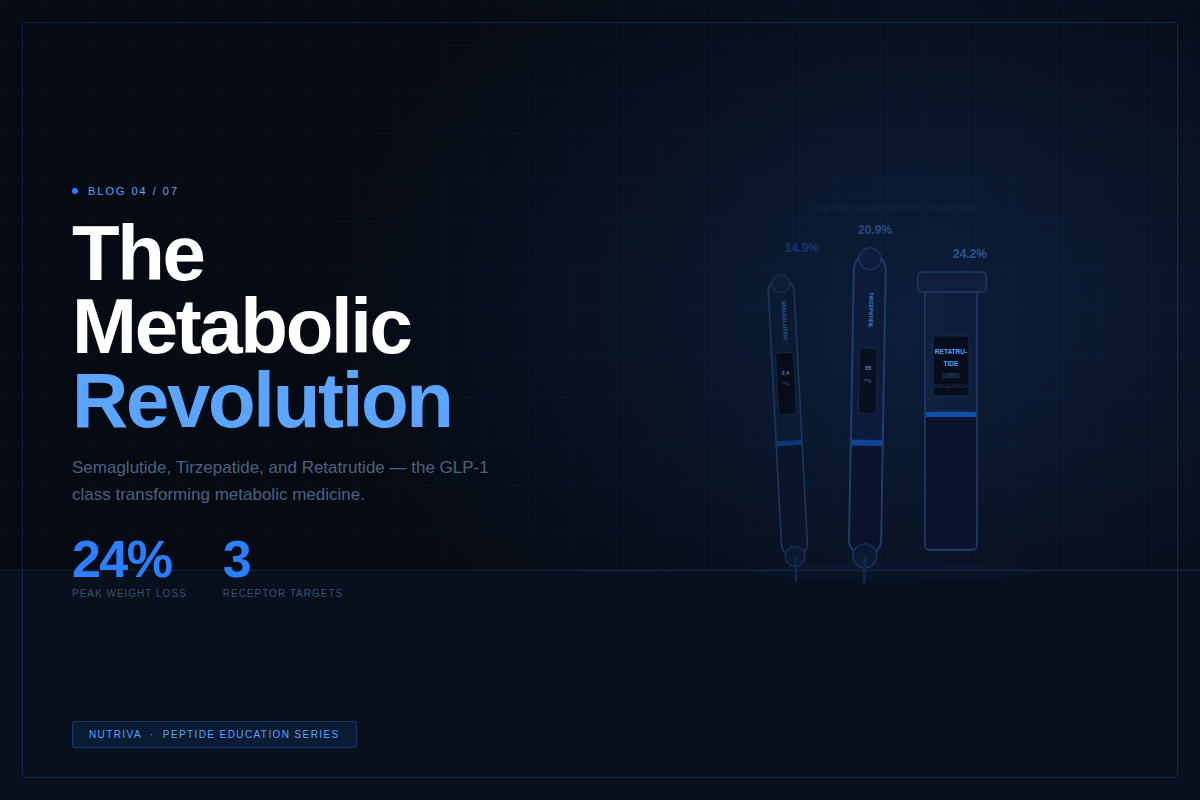
The Metabolic Revolution: Semaglutide, Tirzepatide, and Retatrutide
How incretin-based peptides became the most transformative medical tools of our era — and what they mean for the future of metabolic health Few developments in modern medicine have generated as mu...
Read more