
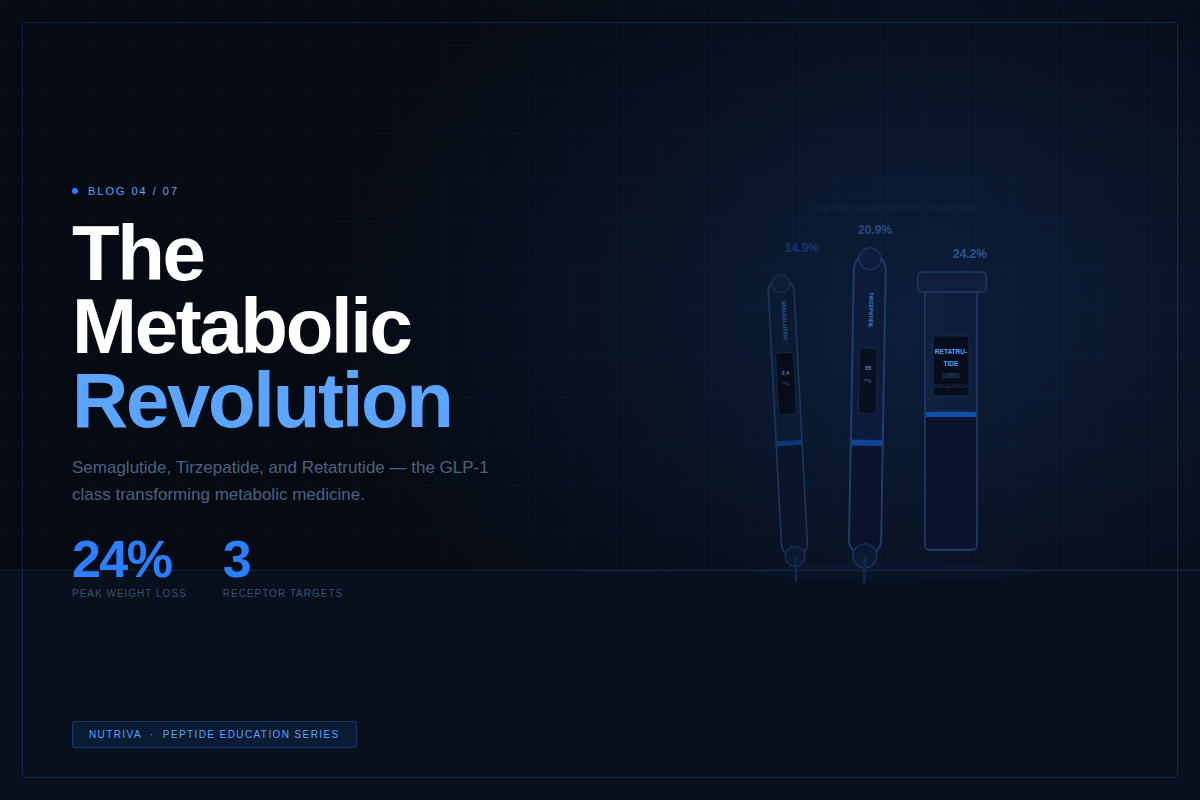
The Metabolic Revolution: Semaglutide, Tirzepatide, and Retatrutide
How incretin-based peptides became the most transformative medical tools of our era — and what they mean for the future of metabolic health
Few developments in modern medicine have generated as much attention — or changed as many lives — as the GLP-1 receptor agonist class of peptides. In just a few years, Semaglutide and Tirzepatide have moved from clinical trials to cultural phenomenon, and a next-generation compound, Retatrutide, is showing results that may surpass them both.
This isn't hype. The clinical data behind these peptides is extraordinary. Understanding what they are, how they work, and what makes each distinct is essential for anyone navigating the modern landscape of metabolic health and body composition.
The Incretin System: A Primer
To understand this class of peptides, you need to understand the incretin system. Incretins are gut hormones released in response to food intake that amplify insulin secretion and regulate appetite. The key players are:
- GLP-1 (Glucagon-Like Peptide-1) — stimulates insulin secretion, suppresses glucagon, slows gastric emptying, and critically, signals satiety to the brain
- GIP (Glucose-dependent Insulinotropic Polypeptide) — also stimulates insulin and has effects on fat tissue and energy metabolism
In obesity and type 2 diabetes, the natural GLP-1 response is often blunted. The peptides in this blog work by activating these same receptor pathways — but with far greater potency and duration than the body's own GLP-1 (which has a half-life of only a few minutes).
Semaglutide: The Peptide That Changed Everything
What Is It?
Semaglutide is a GLP-1 receptor agonist developed by Novo Nordisk. It comes in two primary forms: injectable (weekly) marketed as Ozempic (for type 2 diabetes) and Wegovy (for obesity), and oral form as Rybelsus.
It's a 31-amino-acid peptide with modifications that extend its half-life to approximately one week, allowing once-weekly administration.
The Clinical Data
The SUSTAIN and STEP trial programs have produced some of the most impressive results ever seen in obesity medicine:
- STEP 1 trial (2021): Participants receiving 2.4 mg Semaglutide weekly lost an average of 14.9% of body weight over 68 weeks — compared to 2.4% in the placebo group
- Cardiovascular outcomes: The SELECT trial (2023) showed Semaglutide reduced major adverse cardiovascular events by 20% in overweight/obese adults without diabetes — a landmark finding for a non-traditional cardiovascular drug
- Beyond weight: Emerging research suggests benefits for non-alcoholic fatty liver disease (NAFLD), sleep apnoea, and even early signals around neurodegeneration
How It Works
Semaglutide activates GLP-1 receptors in the brain (particularly the hypothalamus and brainstem), directly reducing appetite and food cravings. It slows gastric emptying (creating a sense of fullness) and improves insulin sensitivity. It also works directly on reward circuits in the brain, reducing the hedonic pull of food — and interestingly, many users report reduced cravings for alcohol and other substances as a secondary effect.
What to Be Aware Of
Semaglutide's most common side effects are gastrointestinal: nausea, vomiting, diarrhoea, and constipation, particularly when initiating or increasing dose. These are typically transient and managed by slow dose titration.
More rare but more serious considerations include a potential (small) risk of pancreatitis and a theoretical concern about thyroid C-cell tumours (seen in rodent studies at high doses, not confirmed in humans). Individuals with a personal or family history of medullary thyroid carcinoma should not use it. These are the reasons it is a prescription medication requiring medical oversight.
Muscle mass preservation during weight loss is a key consideration — adequate protein intake and resistance training are important co-interventions.
Tirzepatide: The Dual Agonist That Raised the Bar
What Is It?
Tirzepatide (Mounjaro, Zepbound) is a dual GIP/GLP-1 receptor agonist developed by Eli Lilly. It's a synthetic peptide that activates both GIP and GLP-1 receptors simultaneously — a mechanism that produces effects meaningfully greater than GLP-1 agonism alone.
The Clinical Data
The SURMOUNT trial program has been exceptional:
- SURMOUNT-1 trial (2022): At the highest dose (15 mg), participants lost an average of 20.9% of body weight over 72 weeks — surpassing Semaglutide's results
- Multiple trials have shown Tirzepatide to be superior to Semaglutide in head-to-head comparisons for both glucose control and weight loss
- Improvements in triglycerides, HDL cholesterol, and blood pressure were consistently observed
Why GIP Matters
The addition of GIP receptor agonism is what distinguishes Tirzepatide. GIP receptors are found not just in pancreatic cells but in adipose (fat) tissue. GIP signalling in fat tissue appears to enhance fat metabolism and may contribute to the superior weight loss outcomes compared to GLP-1 alone. GIP also appears to moderate some of the GI side effects of pure GLP-1 agonism, which may explain why Tirzepatide often has a more tolerable side-effect profile than Semaglutide for some users.
The Broader Picture
Tirzepatide represents a shift in how the research community thinks about metabolic health. Rather than targeting a single pathway, dual agonism acknowledges the complexity of metabolic regulation — and produces results that reflect that sophistication.
Retatrutide: The Triple Threat on the Horizon
What Is It?
Retatrutide is an investigational triple agonist — activating GLP-1, GIP, and glucagon receptors simultaneously. Developed by Eli Lilly, it is currently in Phase 3 clinical trials.
The Phase 2 Data
The Phase 2 trial results, published in The New England Journal of Medicine in 2023, were remarkable:
- At the highest dose (12 mg), participants lost an average of 24.2% of body weight over 48 weeks — the highest weight loss figures ever seen in a pharmacological trial at that point
- Some participants lost over 30% of their body weight
- The glucagon receptor component adds metabolic benefits beyond GLP-1 and GIP, including direct effects on liver fat metabolism and energy expenditure
The Glucagon Component
Glucagon is typically thought of as a counter-regulatory hormone — it raises blood sugar when levels drop. But at moderate receptor activation combined with GLP-1 agonism, the glucagon component of Retatrutide appears to increase energy expenditure (thermogenesis), enhance fatty acid oxidation, and accelerate liver fat clearance. The net effect, combined with GLP-1 and GIP activity, is profoundly effective metabolic remodelling.
What to Know
Retatrutide is not yet approved and remains investigational. Phase 3 data is expected in 2025–2026. The long-term safety profile is still being established. But the early data suggests it will represent the next step in a rapidly advancing field.
The Bigger Context: Why This Matters
The emergence of this peptide class is not just a story about weight loss drugs. It's a fundamental shift in our understanding of metabolic disease. Obesity is increasingly understood as a neurobiological and hormonal condition, not simply a failure of willpower — and these peptides are the first tools to meaningfully address the underlying biology.
For the biohacking and health-optimisation community, they represent something powerful: evidence that highly specific peptide-based interventions can produce transformative physiological changes. The question of which compound is right for whom, at what dose, with what lifestyle co-interventions, is the frontier being actively explored.
A Note on Responsible Access
Semaglutide and Tirzepatide are prescription medications in most jurisdictions, requiring medical oversight. This is appropriate — they are potent agents with real considerations around side effects, contraindications, and monitoring requirements. Anyone using these compounds should do so with proper medical guidance.
Retatrutide remains investigational.
The research-grade peptide community intersects with the clinical world here: pharmaceutical-grade versions are available by prescription, while research-grade versions are available through research channels. Quality and purity are critical for any form — more on that in our upcoming blog on assessing peptide quality.
Next: The longevity frontier — MOTS-c and NAD+, two molecules changing how we think about energy, ageing, and cellular resilience.
Have questions? Chat with us directly on WhatsApp:
Chat with us on WhatsAppRead more

The Growth Hormone Axis: CJC-1295, Ipamorelin, and Tesamorelin
How peptide science is rewriting the playbook on body composition, recovery, and longevity Growth hormone (GH) is one of the most powerful regulatory molecules in the human body. In youth, it driv...
Read more
Repair, Regenerate, Rebuild: BPC-157 and GHK-Cu Explained
Two of the most studied peptides for healing, recovery, and biological renewal If you've spent any time in biohacking circles, recovery-focused fitness communities, or longevity spaces, you've alm...
Read more