
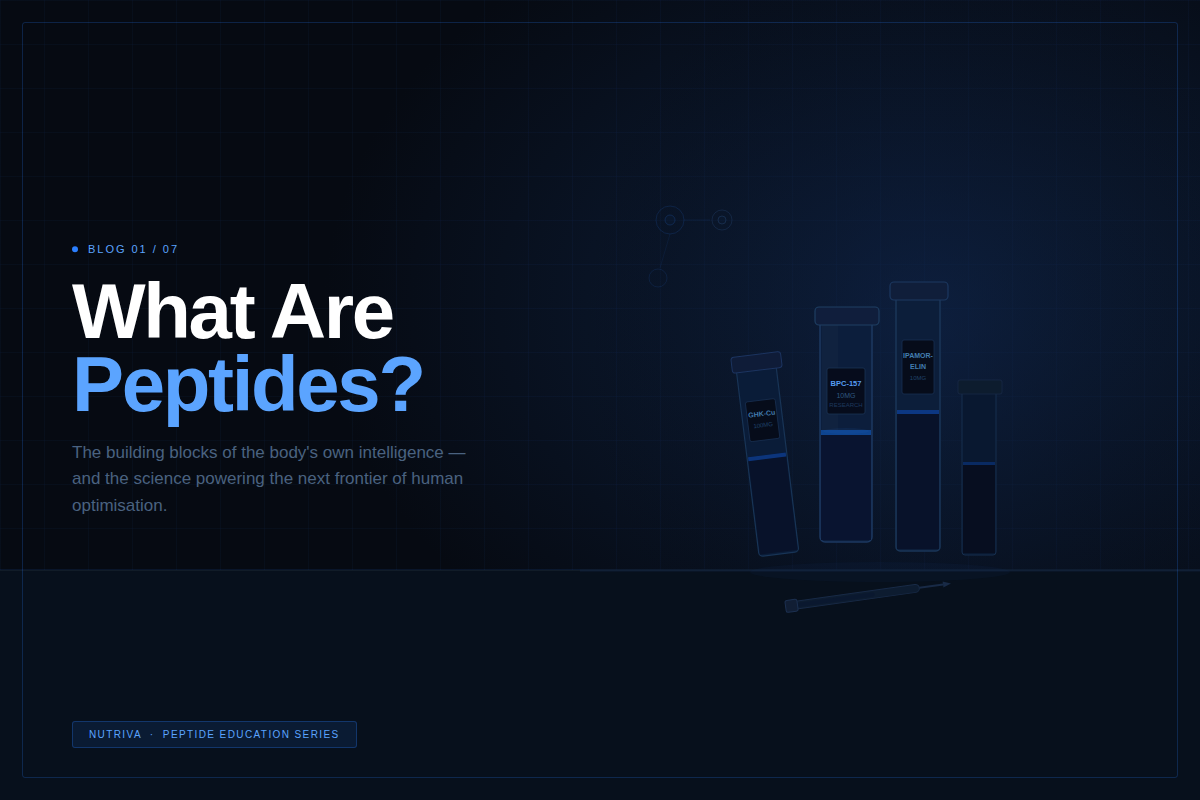
What Are Peptides? The Building Blocks of the Body's Own Intelligence
An introduction to the molecules powering the next frontier of human optimisation
There's a quiet revolution happening in the world of health and performance — and it's being driven not by synthetic drugs or exotic compounds, but by molecules your body already knows intimately. Peptides have become one of the most talked-about tools in the biohacker's arsenal, and for good reason. They represent a fundamentally intelligent approach to health: working with your biology rather than overriding it.
But what exactly are they?
The Simple Version
A peptide is a short chain of amino acids — the same building blocks that make up proteins. When a chain has fewer than 50 amino acids, it's called a peptide. When it grows longer, it becomes a protein. Think of amino acids as individual letters, peptides as words, and proteins as full sentences. Your body is constantly writing and reading this language.
Proteins like collagen, insulin, and growth hormone are all composed of peptide chains. In fact, many of the most important signalling molecules in the human body — the chemical messengers that tell your cells how to behave — are peptides.
The Body Already Uses Peptides Constantly
This is the key insight that makes peptides so compelling from a health perspective. You're not introducing a foreign concept to your body. Peptides like:
- Insulin — regulates blood sugar
- Oxytocin — drives bonding and emotional connection
- Endorphins — natural pain relief and mood elevation
- Ghrelin — hunger and growth hormone regulation
- IGF-1 — cellular growth and repair
...are all peptides your body produces and responds to every single day.
What modern peptide science has done is identify, isolate, and in many cases synthesise specific peptides that have measurable, targeted effects — and made them available in concentrated, research-grade form.
Why the Biohacking Community Is Paying Attention
The appeal of peptides as a biohacking tool comes down to a few core principles:
Specificity. Unlike many supplements or even pharmaceutical drugs, peptides can be highly targeted. A peptide like BPC-157 (Body Protection Compound) has been studied for its role in tissue repair and gut healing. GHK-Cu (copper peptide) has shown remarkable properties related to skin regeneration and gene expression. Each peptide has a job description — and it sticks to it.
Biocompatibility. Because peptides are structurally similar to endogenous (naturally occurring) compounds, the body generally responds to them in a familiar way. Many peptides are broken down into their constituent amino acids after performing their function, leaving no persistent foreign compounds.
Range of application. The peptide landscape covers an extraordinary range of goals: fat loss (think Retatrutide, Semaglutide, Tirzepatide), muscle recovery and growth (CJC-1295, Ipamorelin, Tesamorelin), longevity and cellular energy (MOTS-c, NAD+), skin health (GHK-Cu, Melanotan), and deep tissue repair (BPC-157).
Research-Grade Peptides vs. Pharmaceutical Peptides
It's worth understanding a distinction that matters in this space. Some peptides — like Semaglutide (the active ingredient in Ozempic) and Tirzepatide (Mounjaro) — have completed full clinical trials and are approved as pharmaceuticals. Others, like BPC-157 and GHK-Cu, are widely used in research contexts and by the biohacking community, with a growing body of preclinical and early-stage human data supporting their use.
Research peptides are supplied for investigational and educational purposes. The science is advancing rapidly, and many of today's research compounds become tomorrow's mainstream therapeutics. NAD+ precursors, for instance, have made the leap from fringe longevity tool to mainstream wellness staple in just a decade.
What Makes a Peptide "Work"?
Peptides work by binding to specific receptors on cell surfaces or within cells, triggering downstream effects. It's like a lock-and-key system. The peptide (key) fits a specific receptor (lock) on a specific type of cell, and when it binds, it initiates a biological cascade.
This is why a peptide like Ipamorelin can selectively stimulate growth hormone release from the pituitary gland without significantly affecting cortisol or prolactin — it's targeting the right lock with a very precise key.
The Future Is Peptide-Based
The pharmaceutical industry already knows this. Some of the most significant drug approvals in recent history have been peptide-based:
- GLP-1 receptor agonists (Semaglutide, Tirzepatide, Retatrutide) have transformed obesity medicine
- Tesamorelin is FDA-approved for HIV-associated lipodystrophy
- Peptide therapeutics are among the fastest-growing segments of drug development globally
The biohacking community is simply ahead of the curve — using these tools proactively, for optimisation rather than waiting for pathology to develop.
A Note on Responsible Use
Peptides are powerful tools, and like any tool, they work best when used with knowledge and care. The blogs in this series will walk you through specific peptides, their mechanisms, their research profiles, proper handling and storage, and what to look for when assessing quality.
The goal is to give you the information to make educated decisions — because an informed user gets better outcomes.
Up next: The power of repair — how BPC-157 and GHK-Cu are changing what we know about healing and regeneration.
Have questions? Chat with us directly on WhatsApp:
Chat with us on WhatsAppRead more

Repair, Regenerate, Rebuild: BPC-157 and GHK-Cu Explained
Two of the most studied peptides for healing, recovery, and biological renewal If you've spent any time in biohacking circles, recovery-focused fitness communities, or longevity spaces, you've alm...
Read more
Melanotan 1 and 2: The Science Behind Tanning, Libido, and Melanocortin Receptors
Two of the most discussed peptides in the space — with genuinely different profiles that are worth understanding clearly Few peptides generate as much conversation — or as much confusion — as Mela...
Read more